| Historical review
At midnight of the night from 15 to 16
August 1960, Cyprus ceased to be a British colony and became an
independent Republic. At an official ceremony on 16 August, the last
British Governor, Sir Hugh Foot, handed power over to the first
President of the newly established Republic of Cyprus, Archbishop
Makarios III and its first Vice-President, Fasil Küçük, who were
elected to the State’s highest offices at the first presidential
elections on 13 December 1959.
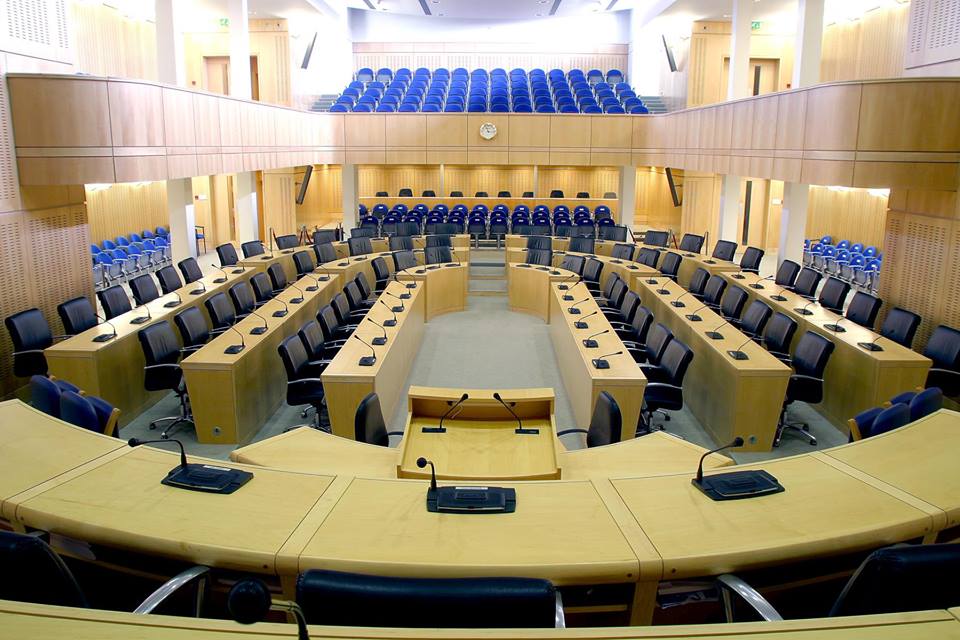
The Constitution of the Republic of Cyprus provides
for a clear separation of powers. Executive power is exercised by the
President, the Vice-President and the Council of Ministers, judicial
power lies with the courts of the Republic and legislative power is
exercised the House of Representatives and the Communal Chambers.
The Zűrich-London agreements and the Constitution of
the Republic of Cyprus contain provisions for the establishment of two
elected Communal Chambers, a Greek and a Turkish one, which deal with
all educational, cultural and religious matters concerning the
two communities.
The first parliamentary elections
took place on 31 July 1960 and, on 7 August 1960, elections were held
for the Communal Chambers. The elections followed a majority system on
the basis of colonial legislation. The number of Representatives was
fifty, according to the Constitution and, out of those, thirty-five
(70%) were elected by the Greek Community and fifteen (30%) by the
Turkish Community.
The newly-established House of
Representatives faced problems in its normal functioning ever
since its very beginning due to the Constitution’s shortcomings. Having
been elaborated by a mixed constitutional committee, the Constitution
given to Cyprus ensured citizens´ basic liberties and rights, but
contained divisive elements, which restricted
right from the start the state’s smooth progress and development.
Provisions to that effect include, inter alia, the right of veto of the
Vice-President of the Republic, the election of separate municipal
authorities by each Community in the five larger towns (except Kyrenia
where there lived but a few Turkish Cypriots) and the separate majority
of Greek Cypriot and Turkish Cypriot Representatives needed for the
amendment of the electoral law and for the adoption of any law relating
to the municipalities or imposing taxes and duties. As a result of this
provision, a small minority of Turkish Cypriot Representatives has the
right to overturn the will of the majority. Using this right in 1961,
the Turkish Cypriot Representatives voted against the Bill for extending
the duration of the Tax Law in force and subsequently also against the
Income Tax Bill, leaving the Republic without relevant legislation for
four years.
After the intercommunal strife of
December 1963, the fifteen Turkish Cypriot Representatives withdrew from
the House and their seats have since remained vacant. All Turkish
Cypriots holding public office or working in the civil service also
withdrew from their posts. The House continued to function, since,
according to constitutional provisions, it can deliberate if at least
one-third of the total number of Representatives is present.
Important developments took place
on the Cyprus political scene in the years that followed. The posts
vacated by the three Turkish Cypriot Ministers, who withdrew from the
Government, were taken over by Greek Cypriot Ministers and the
competences of the Supreme Constitutional Court were transferred to the
Supreme Court. In March 1965, the House enacted a law, through which the
legislative powers of the Greek Communal Chamber were transferred to the
House of Representatives, competences on educational, cultural and
teaching issues were transferred to the Ministry of Education,
established by the same law and the rest of the Chamber’s administrative
functions to other relevant Ministries.
Due to the irregular situation caused by the dramatic
events to 1963, the next parliamentary elections were not held in July
1965, but only on 5 July 1970, with the Representatives´ term of office
being renewed every year through relevant legislation. The coup d´ état
of 15 July 1974 and the Turkish invasion of 20 July 1974, the occupation
by Turkish troops of 37% of Cyprus´ territory and the violent expulsion
of about a third of the population from their homes and properties resu lted
in the elections being postponed yet again. The next parliamentary
election in the Republic of Cyprus was held on 5 September 1976.
In the terms of office that
followed, the House took another task upon itself: the enactment, in
cooperation with the executive, of special legislation for the equitable
distribution of burdens brought about by the Turkish invasion and
occupation, as well as of other legislative measures aiming at the
restoration of the country’s economy and relief of the displaced, other
victims and the relatives of missing persons. The House has since been
taking active part in the people’s struggle for finding a just and
viable solution to the Cyprus problem at both the local and
international level.
The decision taken by the House on 20 July 1985 to
increase the number of its Representatives to eighty constitutes an
important landmark in the Parliament’s history. Fifty-six of them would
be elected by the Greek Community and twenty-four by the Turkish
Community in order to preserve the 70:30 ratio provided for in the
Constitution. This decision was taken invoking the law of necessity,
since the Constitution calls for separate majorities of Greek Cypriots
and Turkish Cypriots in the case of the relevant amendment. The increase
in the number of Representative ’s
was required ipso facto, since, due to the multiplication of the
Parliament’s activities and its participation in several international
parliamentary organisations, the fifty existing members could no longer
carry out the work of the Legislature properly and especially that of
parliamentary committees. |